In Other Moonlights
First published in Chinese in Artforum (artforum.com.cn), August 19, 2026. The English translation follows; for the Chinese version, see the original page.
中文原文刊于 Artforum 中文网(2026 年 8 月 19 日),请见原文页面。
Beijing
In Other Moonlights 月下兼差
tbc projects 临时计划
Mudan Innovation Technology Incubator, Jiuxianqiao, Chaoyang District
June 27–August 30, 2026
The office park that houses the Mudan Innovation Technology Incubator sits somewhat off the beaten track and keeps the look common to industrial parks of the early 2000s: blocky gray-white buildings fitted with faintly bluish glass, with large dark-red characters in a heavy sans-serif standing on the rooftops. The route to the exhibition space is rather circuitous—up the stairs, into an elevator, across to another elevator, and then a search by room number—and since most of the rooms along the way are the offices of tech companies, I could not help guessing which of the people I passed were visitors to the exhibition and which were the place’s rightful “natives.” An art exhibition concealed among the routines of the working day: in this respect the exhibition’s Chinese title, 月下兼差, is rather apt.1
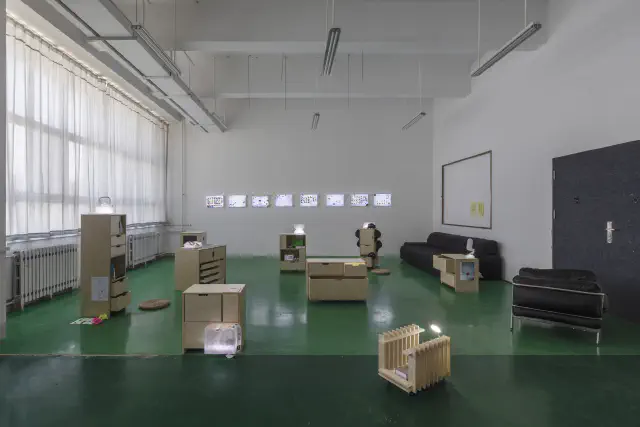
The gallery is dim, somewhere between white cube and black box. Curtains filter out the direct light, wood-toned filing cabinets are scattered through the room, a sofa sits in one corner, and lamps of assorted shapes stand on or beside the cabinets. The whole space feels more like an office drowsing through the midday lull, the kind that makes one want nothing more than to sink into the soft, dark sofa, gaze at the roomful of files, and doze off.
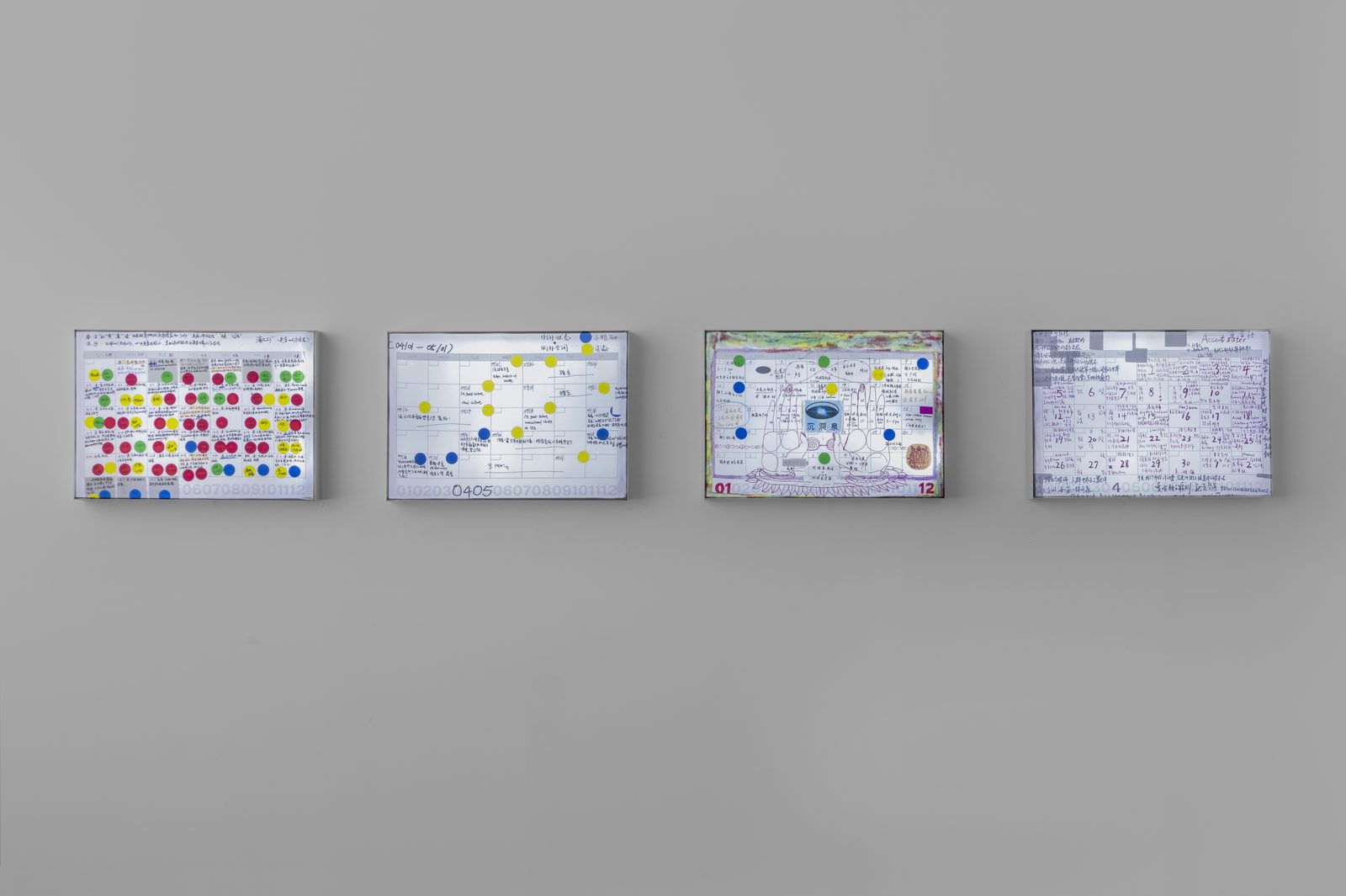
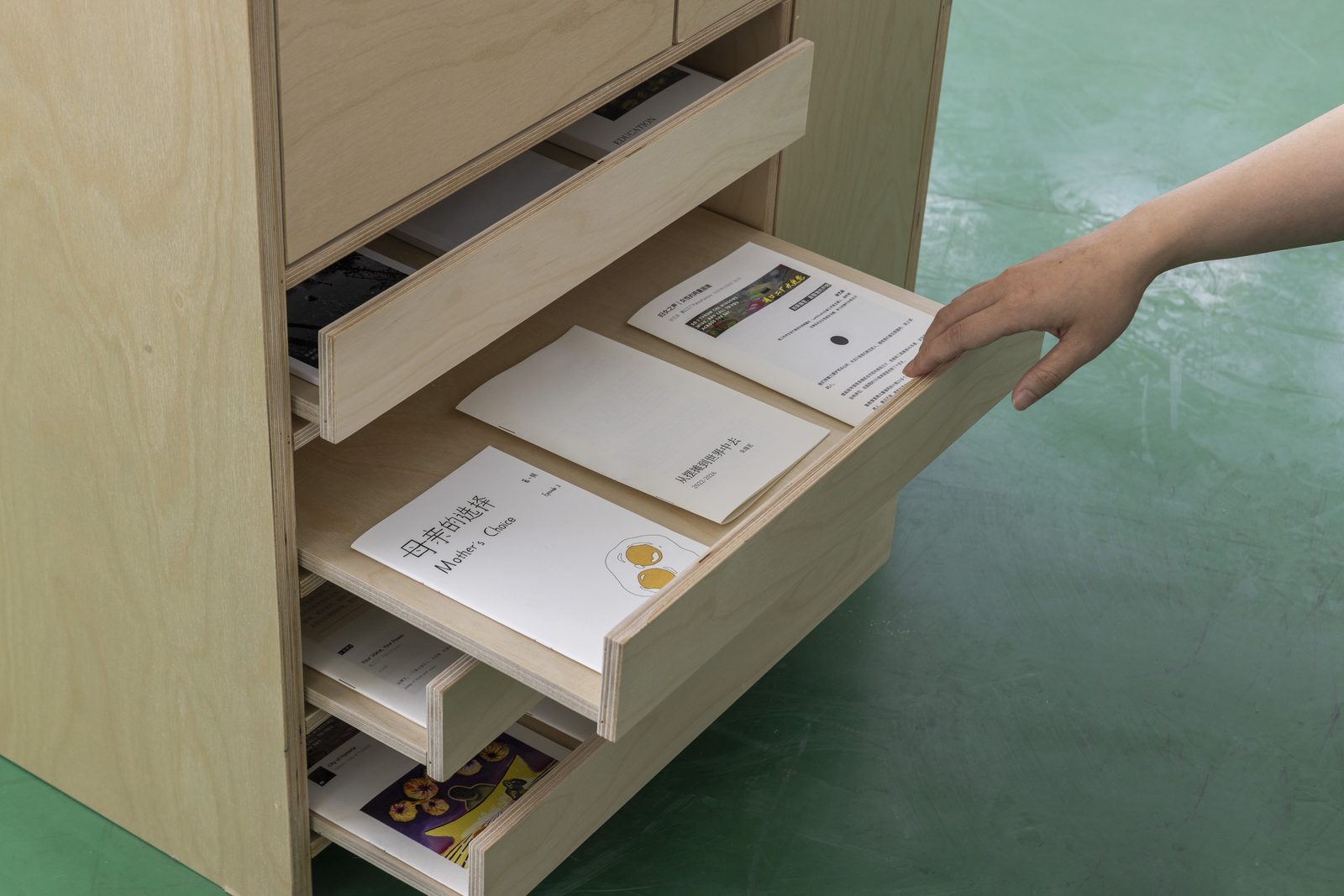
In a long conversation, the three artists who organized the exhibition together as Pararailing (栏杆外, literally “outside the railing”) characterized the undertaking as “weak curating.” Judging by the final presentation, however, In Other Moonlights still organizes the display and the reception of its eight “broadly cultural” projects through a clearly defined structure. The materials of each of the eight groups are placed, for visitors to leaf through, in a cabinet of drawers designed jointly by Pararailing and the group, and each cabinet is accompanied by a lamp modeled on an object emblematic of the group’s practice and by a monthly calendar2 recording work, non-work, and life. While the exhibition preserves the openness of an archival display, it also arranges these disparate practices into a uniform format of one group, one cabinet, one lamp, one calendar. Wood tones, fabric curtains, and low light produce a gentle, intimate atmosphere, and “beneath the moon” thereby acquires an almost romanticized spatial form.
In Other Moonlights, installation view, tbc projects, Beijing, 2026. Photo: Yang Hao.
The exhibition booklet unfolds from the multiple senses of the English word moonlight. Setting aside its literal meaning as the light of the moon, along with its standing in poetry, music, and popular culture as “the byword for tenderness and solitude” (an image from which the text deliberately keeps its distance: “so universal and borderline cliché”), the organizers’ affirmative claims rest on the three senses that follow: the Moonlighters, members of a secret society in the Irish Land War of the nineteenth century; moonlighting, taking on a second job alongside one’s regular employment; and moonlights, pluralized to emphasize the singularity of each of the eight practices in the exhibition. From this cluster of meanings, the invisibility of cultural labor, the scarcity of resources, and a drift away from the linear timeline of a “career” are woven together. The curatorial text goes on to speak of gathering, cooking, arguing and then making up, and of how “in the darkness we grope for a way of working together, a shared practice that sustains us, that we in turn are committed to sustain.” Moonlighting thereby acquires an affective and ethical standing: the labor goes unseen and the circumstances are precarious, yet the practitioners keep their practice going by holding one another up through close personal bonds.
In Other Moonlights takes place in Beijing. In that conversation, the three organizers described the participating projects as “broadly cultural,” and they also stressed that the exhibition ought to happen in China, so that the place of its happening becomes a condition under which this chain of concepts is put to the test. Curatorial judgment can answer to the cultural context it faces only by setting out from concrete practices and adjusting itself continually in its back-and-forth with its objects, rather than by descending as a preset framework over all of them alike. The Chinese 月下, “beneath the moon,” ought likewise to take part in revising this chain of concepts from the other direction. In the Chinese poetic tradition the moon is entangled with love, with drinking in company, and with longing for home, and it is also a medium that joins people separated by distance.3 The moon of “at the ends of the earth, we share this hour”4 and the English moon of “tenderness and solitude” organize different imaginaries of relation. “Relation” itself is not absent from the exhibition: the eight projects are linked to one another through the contributors and the network of friends around Railing Codex, the dictionary-style writing project Pararailing began in 2022, and a good number of the practices grew out of shared living, gatherings, and community. Yet next to the full elaboration that the English senses receive in the curatorial text, the relational tradition to which the Chinese 月下 points remains, for the most part, a matter of spatial atmosphere and emotional rhetoric.
Still, the exhibition’s most valuable achievement is to let these practices, which span art, publishing, podcasting, and community organizing, refer to one another, and to give prominence to the process of practice rather than to its products. The “After Work” archive brought by Accent Sisters (重音社) comes from an exhibition devoted to people without formal art training, who work in non-art jobs by day and go on making work once they are off the clock. TightBelt’s cabinet holds a questionnaire for newcomers to the art world, a commemorative publication titled Shall We Prosper? (小康了吗?),5 and interviews with art workers conducted over several years. The two hosts of the podcast Instant Acumen (热敏修辞学) choose a single word for each episode and talk about it against the clock; in the exhibition, notes from twenty episodes are printed sheet by sheet on thermal paper, so that words such as “travel,” “jealousy,” and “perseverance” take on new definitions as they pass through personal memory and present feeling. Pukou Factory began with several young people living together in Pukou, a district of Nanjing, and through its WeChat official account and open calls such as “Women’s Voices” it has let scattered experiences of women encounter one another. These materials give the “broadly cultural” a concrete shape: practices once dispersed across WeChat accounts, podcasts, and networks of friends enter a public setting in which they can be looked at seriously and read against one another.
In Other Moonlights, installation view, tbc projects, Beijing, 2026. Photo: Yang Hao.
Here, too, lies the exhibition’s delicate point. The curatorial text seeks to lend visibility to the invisible condition of cultural labor, yet in the process it may also presuppose a common image for that visibility. The materials in the eight cabinets do not stand at equal distances from the conceptual frame of moonlighting, and their understandings of labor, of making, and of perseverance differ from one another. When Instant Acumen takes up “perseverance,” it does not treat it as an inherently lofty virtue, since giving up can be an equally reasonable and freely chosen course; Mamahuhu (马马虎虎, roughly “slapdash”), for its part, develops “so-so” and “close enough” into a working method that accepts the contingency and imperfection of whatever happens on site. The ease these practices display, and their reservations about perseverance, stand in a tension, never adequately worked through, with the laboring posture the curatorial text depicts, that of holding one another up and working on in the dark. On the one hand the curatorial framework uses the plural moonlights to emphasize difference; on the other, through a uniform spatial grammar, it gathers the eight practices into closely neighboring affective and aesthetic positions. Visitors may therefore, without meaning to, carry into their understanding of some of the projects a posture of endurance and perseverance, even the image of a subject living in permanent crisis, none of which the projects themselves necessarily set out to emphasize. To go a step further and infer directly, from the closeness of a network of friends, a political subject bound together by mutual support and shared perseverance would be to cross a distance that still requires argument.
Concepts and historical resources from elsewhere can take part in reflecting on contemporary cultural production in China, but once a concept enters a concrete context, it too must submit to being tested and rewritten by local practice. In Other Moonlights succeeds in letting these practices be seen in a single room; to make good on its promise of “a constellation of singularities,” it would further need to let the local relations and divergent postures these practices carry rewrite, in turn, that beam of “moonlight” organized chiefly through English—otherwise the account that local cultural production gives of itself may remain a “calque”6 of an existing discursive framework.
Top image: In Other Moonlights, installation view, tbc projects, Beijing, 2026. Photo: Yang Hao.
-
月下兼差 (yuèxià jiānchāi), literally “a side job beneath the moon.” 月下 is a common image in classical poetry and appears in 花前月下 (“before the flowers, beneath the moon”), a set phrase for romance; 兼差 is colloquial for a side job. ↩︎
-
月历, a monthly calendar; 月 means both “moon” and “month.” ↩︎
-
For example, Li Bai’s “Quiet Night Thoughts” (静夜思), in which the moon prompts thoughts of home, and “Drinking Alone Beneath the Moon” (月下独酌), in which the poet raises his cup to the moon. ↩︎
-
Zhang Jiuling (678–740), “Gazing at the Moon, Longing for One Far Away” (望月怀远): “Over the sea a bright moon rises; / at the ends of the earth, we share this hour” (海上生明月,天涯共此时). ↩︎
-
Literally “Are we xiaokang yet?” 小康, “moderate prosperity,” is the official term for China’s national development goal, declared achieved in 2021. ↩︎
-
See also “China Is a Calque of Modernity.” ↩︎