A World Awaits
English
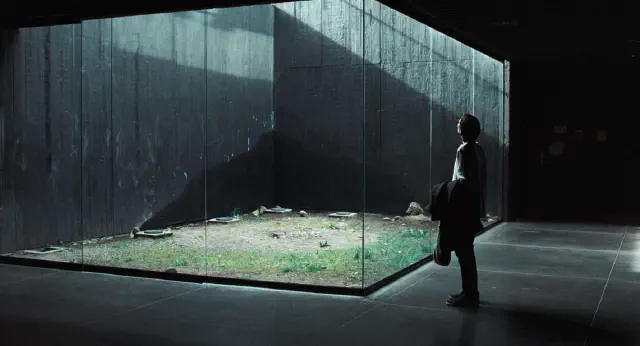
In recent years, among the work of artist friends around me, “memory” and “time” have appeared alongside AI, databases, and futurism with increasing frequency. A few years ago, I accompanied several friends to Lincoln Center to see Memoria by the Thai director Apichatpong Weerasethakul. The camera drifted slowly through the damp rainforests of South America; through the protagonist’s somnambulant gait, time itself drifted in nonlinear ways. Though these works were made in recent years, what they presented was a weary old world, carrying the texture of a dream occurring elsewhere. Commentators on popular culture have likewise noted the same trend of recycling past cultural elements. Seen generously, this amounts to a kind of homage to earlier styles—the aesthetics of Y2K, futurisms born in the 1970s and ’80s resurfacing in the cultural products of the 2020s, and so on. If those born in the 1980s are merely pining for their own youth, then the resonance that post-2000 generations feel toward “dreamcore” aesthetics—assembled from visual elements of the late 1980s and ’90s adolescence—cannot be explained at all: why do people feel nostalgia for symbolic registers they never lived through? What worries cultural scholars more is whether this reflects a collective loss of the capacity to imagine the future. In a controversial 2012 article, “You Say You Want a Devolution?”, American writer Kurt Andersen observed the phenomenon of cultural development getting “stuck”—from pop music to fashion, an endless cycle pointing back to past styles.1 British writer Simon Reynolds expressed a similar judgment in his 2011 book Retromania: Pop Culture’s Addiction to Its Own Past.2 Their paths differ, but the phenomenon they identify is the same: contemporary culture has, to some degree, lost the ability to produce the “new,” or at least lost the ability to make the “new” recognizable as such. In their analyses, “technology” comes up again and again. Reynolds discusses the influence of internet video platforms and the way remix culture is, as a technique, an encouragement to sample old material; Andersen, for his part, makes a crucial observation: while culture gazes endlessly backward and old elements circulate, technology stands as the exception—its development has not stagnated but has, over the past two decades and more, accelerated dramatically.
In Hartmut Rosa’s argument about whether society is experiencing acceleration, he defines the rate at which past experience loses credibility as the measure of social acceleration: past experience becomes obsolete at an ever-increasing pace, leaving us bewildered about what the “present” even is.3 In response to this condition, serious creative work—work that constitutes a world of meaning—keeps its gaze fastened on the old world, presenting it through memory or dream; meanwhile, popular culture opts for the direct reuse of old elements.
A similar observation can be drawn from the words we use to label decades. The 1980s, the 1970s—these are widely accepted, definable temporal strata. But since 2000, for various reasons, we have lost the language that aggregates a stretch of time into a single label. The causes cut both ways: either there is insufficient cultural specificity for an aggregating term to arise, or the terms themselves—“the tens,” “the twenties”—are already firmly wedded to 1910 and 1920, creating a naming difficulty that obstructs our perception of these decades as distinct from one another, as objects available for thought. In any case, in our collective memory, the dozen-plus years since 2010 have congealed into a single blurry mass. “The three years lost to the pandemic” has gradually lost its explanatory power: we have not merely lost three years—even 2016 feels like yesterday.
Born at the tail end of the 1980s, I came of age at the turning point between the maturation of heavy manufacturing and the rise of the internet information industry. To a considerable extent, the shift from the secondary to the tertiary sector was not only the master narrative of 2000 to 2020 but also an undercurrent in my own personal narrative. In my adolescent memory, the physical world I associated with the word “city” was not glass-curtain-walled office towers or vast intersections teeming with people; it was colossal factories, row upon row of smokestacks, and silver pipes as intricately tangled as an early Windows screensaver. This was the scene of the industrial zone; the other half was the “support district”—the residential area where factory employees lived. Apart from the air quality, which was unavoidably affected, the living quarters bore almost no trace of the factory most of the time; there were only bustling wet markets, blocks of apartment buildings, and schoolchildren bicycling to and from class. The concept of the “ancillary” district (peitao) encodes a particular logic about how facilities exist: the residential zone is subordinate to the production unit; dwelling is a function arranged in the service of labor. When this logic is carried to its conclusion—as when Los Alamos was built from scratch for the sole purpose of manufacturing the atomic bomb4—the existence of every object is exhausted by its utility, all things become transparent means, and people cannot dwell among them, cannot encounter beings face to face; a world struggles to unfold, and meaning finds nothing to adhere to.
The small city where I grew up was, of course, nothing like such a blueprint. It had existed long before industrialization, and so contained a great many things inconvenient for industrial production—things that could not be conscripted by the logic of “support.” Not far beyond the city limits ran a wide national highway, flanked by fleets of trucks; cross the highway and you arrived at vast stretches of farmland, the typical landscape of the North China Plain. The city also had its own history: in ancient times it had been the capital of a certain kingdom, and although this had not turned it into a tourist destination, rudimentary yet still-maintained museums and archaeological pits were scattered inside and outside the city. Street names, accordingly, reflected this history. The inhabited areas were a considerable distance from the factory zone—at least for a teenager whose only means of transport was a bicycle, the distance felt impossible to cross. As in many other industrial cities, the boundary of the residential district was lined with railway tracks and factories that had opened and closed at unknown dates. My childhood companions and I would occasionally venture to this border, climbing walls to enter plants that may have been shuttered ten or thirty years earlier, pilfering a few pieces of scrap iron to sell for popsicle money. To us, this boundary was like a frontier—a dividing line between worlds—as though some solemn enchantment separated one side from the other. “Go any further and you are in a different world”—this signal emanated from every blade of grass, every rusting machine by the roadside. And so my companions and I, young as we were, never crossed that threshold. It was as though the shuttle bus our parents took to work was the only vessel capable of passing through the border to the industrial zone—as though to cross the River Styx, one could only go by Charon’s boat.5
According to my parents’ generation, the small city had once been a different world—abundant rivers and even more farmland—gradually displaced during their formative years by enormous factories, tons of steel, and countless trucks. That world now exists only in the prose of Liu Liangcheng. Yet the new world opened by industry itself became the sensory condition of life for the next generation. For me, though I left the small city more than twenty years ago, my dreams are still filled with towering smokestacks trailing white vapor, and with the distinctive smell of green grass in winter air. Even a taco truck—one that belongs in Brooklyn—pulls up on the street at the compound’s entrance, set up against the back door of the canteen. Always accompanying these things are bulky CRT monitors and the startup chime of Windows 98 or XP. All these textures of touch and sound, large and small, issue from plastic, from steel. These materials are not perceived as discrete objects to be identified one by one; rather, they function as a diffuse attunement (Stimmung)6—before we have even noticed it, they have already placed us within a particular world and, in their own way, unfolded for us a world to which memory can adhere, in which one can dwell, and from which meaning can grow.
And as that world—bearing on its skyline the silhouettes of factories, the popsicles bought with scrap iron, the railway tracks lining the city’s edge, and the train whistle drifting from some distant place in the dead of night—gradually recedes and blurs, we find ourselves slowly adrift in a vacancy left behind by the dissolution of affective bonds. The world that ought to have arrived has not yet—or perhaps has always already failed to—arrive; in its place, certain unnameable behaviors and objects have taken hold of our present attention.
At MoMA PS1’s large-scale summer 2025 exhibition “The Gatherers,” what filled the galleries was still enormous machinery and parts, cluttered domestic objects in video works, hardware tools scattered in corners, and all manner of small plastic things that could probably be called trash—all of it unmistakably the signature output of modernity, manufactured in the workshops of various factories, belonging to the same world as tile-clad exterior walls, towering smokestacks, and distant whistles. Curator Ruba Katrib, in an interview, said: “There’s something palpable that emerges. The sound of the scanner, the sound of the building grapple, and then every four minutes Klara Lidén’s sign rotates. The mechanical sounds repeat in a particular way, creating an evocative rhythm. These sounds speak to a quality that is hard to put into words, and that is exactly what an exhibition and art can do.”7 If artworks possess the capacity to “put forth a world,” if they are the site where the tension between “world” (Welt) and “earth” (Erde) is maintained,8 then within the double movement of industry’s recession and information technology’s ascendancy as subject, can the latter bring a new world into presence the way the former once did?
Information philosopher Luciano Floridi predicted as early as a 2007 paper that we are entering an era in which information is ontologically primary—the physical world will no longer enjoy ontological priority but will merely become a subset of the “infosphere.”9 Floridi takes no ethical stance, for or against, when articulating this rupture, which makes his judgment all the more credible.
Rhizome is the most important research and archiving institution in the field of net art. The digital art it deals with represents the “softest” category of its kind—work that exists purely in cyberspace. Almost concurrent with MoMA PS1’s “The Gatherers,” Rhizome also mounted a large-scale physical exhibition, “Rhizome World”—an attempt to gather a world through software alone. Unlike the PS1 show, if you pulled the plug, the space would have looked like a trade show for different display technologies: seventeen-inch and thirty-inch monitors, some on desks, some mounted on walls, plus projectors with their requisite screens and LED floor-standing displays. This far-from-dense array of screens did not resemble a typical art exhibition—though it carried something of the quiet intentionality of a reading room, or perhaps the charged anticipation of an early internet café. It was clean and orderly. Naturally, what viewers come to see is not the screens themselves but what lives inside them. The screens, keyboards, and mice—this hardware—exist only to make visible to us what lives inside the screen; they are the vehicles through which the exhibition’s content appears. Among Rhizome’s own collection are many works involving the experience of the early internet—things somewhere between software and games—whose sounds and visuals sent me back, more than once, to a certain era of the World Wide Web and the colors it once promised. I went to “Rhizome World” repeatedly. But in the many days after leaving the exhibition, when I tried to recall the world it had presented, what came back to me was the smell of warm plastic from the computer room of my childhood. If the “world” in “Rhizome World” aspired to be a Heideggerian world, the world it actually signified could not yet fully depart from the internet café or the office—such sites of entrustment, though perhaps also sites of incubation. To be fair, Rhizome’s curatorial problem is often fundamentally one of archiving: respecting what net art is, rather than transmuting it back into the very thing it grew out of and deliberately left behind. While searching for reviews of “Rhizome World,” I stumbled upon an independent critique that pointed directly at a certain impasse of digital net art: “We have screens at home—why go to a museum to look at more screens?”10 The answer may be that software, so far, has overwhelmingly been contextualized within a homogenized world; the world Rhizome posits here performs a necessary recontextualization—a place where software can gather and take its first stride toward an ontology of its own.
What is software, exactly? Treating it as a “thing” on par with real, physical objects runs against intuition. In media scholar Wendy Hui Kyong Chun’s book Programmed Visions: Software and Memory, she recounts how, at the very dawn of software, there was a case in which a software engineer attempted to patent software but was denied by the court. The court’s rationale was that software belonged to the domain of natural-scientific discovery—a kind of mathematical finding or natural law.11 In other words, software was initially regarded as an epistemological instrument. Although subsequent economic considerations eventually allowed software to be sold as a commodity, for a long time its physical medium—the CD-ROM or the floppy disk—remained the thing actually being sold. Those discs that shimmered in rainbow colors under the light, grippy yet slick to the touch, became a kind of visual symbol of the early Chinese computer market.
In the middle portion of her book, Chun’s analysis comes to rest on software as logos and action. As another software studies scholar, Alexander Galloway, develops in The Interface Effect: “Computer is an ethic.”1213 Although Chun partly rejects Friedrich Kittler’s claim that “software is merely differences in hardware voltage”—that is, that “there is no software”14—on the question of whether certain things can “open and sustain a world,” Kittler and Chun would likely agree. Software can be merely difference; it can also be logos, or a manner of conduct. But what these scholars share is a negation: the denial of software’s status as a “thing,” each pointing instead to its distinct and peculiar mode of being. Software can only rework the meaning and relations of what already exists; it cannot perform ontological addition or subtraction—the way a factory rises from flat ground, a forest is converted into farmland, slag accumulates into a hill, or fine particles drift through the air. In this respect, software appears to lack what Heidegger calls “thingly character” (das Dinghafte).15 It cannot, like a jug or a bridge, “gather” a world and open a clearing (Lichtung). Instead, as Galloway theorizes, it operates as an effect upon what already exists; or, as Chun puts it, it affects and transforms the temporal structure of our experience of the world itself.
With the arrival of ubiquitous personal connectivity, led by the smartphone, a bus is still a bus—its mechanical design and construction have not undergone major changes—but the bus as an object of waiting, as a tool of commuting, as a node in urban transit: these very “as” relations become the targets upon which the information industry operates at the level of effect—producing data, that is, information restructured into networks of meaning. Since the millennium, information technology has become the default technology for solving any problem. And so even the venerable name “information technology” (IT) has retreated behind the curtain, replaced by the catchall “high tech”—the implication being that high tech simply is information technology. This is an enormous ontological and epistemological rupture, yet it is nearly inaudible in the physical world—except, of course, for the enormous data centers being ceaselessly built. But even these massive structures are typically hidden in sparsely populated regions, beyond the reach of everyday thought. Software’s mode of being consists, first, in its effect upon the existing world—upon that “referential totality” within which human beings exist, Heidegger’s “world”16—reshaping the network of meaning that lets beings appear as what they are.
And yet, if we accept that the essence of software is logos, or a code of conduct; and if we agree with Marshall McLuhan’s observation that “the medium always contains other media”17—then the great majority of software to date has not been pure software—that thing once considered akin to a mathematical discovery—but rather a grand assemblage of traditional media: images, video, sound. The “Media” folder in software development, the massive “Assets” directories in game development, all point to the same fact: for a very long time, software has been a composite, containing both behavioral logic and logos alongside vast quantities of “old media.” Winamp, the iconic media player of the 1990s and a symbol of its era, was a “composite” application loaded with enormous quantities of bitmap files. Cory Arcangel, a frequent name in the net art scene and a recurring presence in Rhizome World, offers another case in point: his Super Mario Clouds strips a game down to its hand-drawn pixel sky, and what remains — a mere sliver of the whole — opens onto a peculiar world-experience of its own kind. World of Warcraft pushed this composite to the scale of multiple gigabytes: hundreds of designers transcribed field-recorded birdsong, orchestral performances, and hand-drawn concept art into a single installation package. Its promotional slogan when it entered the Chinese-speaking world—“A World Awaits”—turned out to be honest: for a teenager whose life experience was confined to the North China Plain, Azeroth gave me my first dense forest, my first desert, and my first swamp. The soundscape drifting among the ancient trees of Teldrassil, the afternoon light in Elwynn Forest, the distant drumbeat carried across the arid wastes of the Barrens—all of these, with a sensory density I had never before encountered, settled into my body as the first experience of a certain world. Years later, hiking through the woodlands of the American Northeast, the stillness of an autumn broadleaf forest and the sounds of birds and insects each called forth its own presencing—and yet, carried within it, there was also the air of Elwynn Forest.
If composite software can deposit in the body a kind of primal experience of a world—and this deposition is possible because the “old media” materials within the composite carry their own historicity; Yuk Hui, in Recursivity and Contingency, locates “historicity” as the temporal structure in which past experience, as an unfinished condition, continues to participate in the constitution of the present18—while the statistical relations within parameter tensors do not preserve this unfinishedness but instead flatten the past into probability distributions—then the question is no longer “whether software itself can bring forth a world” but rather: what form of software, and what constitutes “creation” in software.
Since the 2010s, however, a new kind of software has begun to enter the public’s daily field of vision. From the theoretical vantage of Chun and Galloway, it comes even closer than early DOS to software in the pure sense—a purely mathematical operation. To call it “mere software” (borrowing from Heidegger’s “mere thing”)19 may be more apt.
In 2023, American illustrator Sarah Andersen and others filed a class action lawsuit against Stability AI and Midjourney, alleging that AI companies stole artists’ images and “stored” them inside models.20 This intuitively plausible interpretation missed the mark: technically speaking, the model does not “store” any individual piece of media but only hundreds of millions of numbers and algebraic relations—a set of high-dimensional parameter tensors. As researcher Eryk Salvaggio analyzes, large models are statistical models, not “explanatory models” in the public imagination—statistical models possess no understanding of their data, hold no hypotheses about causation, and merely produce, as if drawing a map, the relations between data points.21 Precisely for this reason, “hallucination” is not an occasional malfunction but the only form of generation the model possesses—the model is hallucinating at every moment. And this hallucination is itself ahistorical: its disordered generation does not arise from the sedimentation of history but from pure probabilistic emergence.22
Precisely because large models are understood as a kind of generative engine, turning to them for art-making has naturally become a path many artists pursue — and unlike the structural impasse of exhibiting born-digital work in physical space, a purpose-built AI installation has full command over its own visual language. Refik Anadol’s Unsupervised appeared in the MoMA lobby in the winter of 2022, its abstract colors and lines shifting back and forth across a massive screen. Art critic Jerry Saltz called it “a glorified lava lamp”—a judgment that, whatever its crudeness, points to a failure of choice rather than of medium.23 The fact that the work was trained on MoMA’s collection data could have served as an entry point into a certain world: if viewers could discern Mondrian’s grids or Pollock’s drips within the flowing forms, the work might have become a meditative apparatus for the history of modern art. But the visual language Anadol chose precisely foreclosed this possibility of retrospection—the “window” implied a space behind the screen that one might enter, but that space contained nothing beyond more particles.
As Reynolds has observed, contemporary music production relies heavily on remix and sampling, and the resulting works hover between homage to the past and outright appropriation, the line between them blurred.24 Among these “new” categories, a branch commonly called “TikTok Breakcore” has emerged.25 These works possess a highly recognizable set of audiovisual markers: album covers almost invariably feature melancholic Japanese anime girls; dense, rapid electronic drum patterns produce an irresistible sense of mechanical propulsion; and floating above this rhythm are ethereal, gossamer melodic lines—fragments sampled from 1990s Japanese animation soundtracks and early video game scores, processed yet still retaining a certain wistful sweetness. For those who grew up in the 1990s, this coincided with the so-called second stable period of Sino-Japanese cultural exchange, when television stations aired many Japanese anime around six in the evening—and these samples appear, unhurried, in “TikTok Breakcore.” Beyond this, many other elements of the old world are mixed in as well—for instance, the Windows 95 startup sound, repurposed into a track called “Windows Breakcore” that has garnered over two million plays on YouTube. Its cover art is that famous XP green-hills-and-blue-sky wallpaper—an image so iconic it has become the representative picture for the Xiaohongshu tag “aesthetics of an era of economic ascent.” I often find myself cycling through traffic during my commute, this kind of music blaring in my earbuds—the dense, rapid, mechanical drum patterns dragging my equally mechanical body forward at speed, while the slow, melancholic melodic line keeps glancing backward, carrying the voice of a 1990s anime girl. Perhaps precisely because these samples from the old world point toward a denser, weightier world, breakcore musicians seize these fragments of the old world and strain to piece together a clearing fit for dwelling. And right there—at the moment when the body is driven forward by the beat while the heart clutches the melody and looks back, when the infrastructure of meaning is steadily becoming ahistorical particles, and the things that once preserved an entire world for us inside an installation package are being dissolved by the same force—longings and feelings lose their place of shelter, grasping desperately at a past that is vanishing beyond the window.
中文
大工业生产所造出的旧世界已渐然谢幕,环境中留下被改造的巨大痕迹;而新信息产业之产出是否可以为我们打开一个可栖居的新世界?
《记忆》剧照© Kick the Machine Films, Burning, Anna Sanders Films, Match Factory Productions, ZDF/Arte and Piano, 导演:阿彼察邦·韦拉斯哈古,2021年
近些年,在身边艺术家朋友的创作中,“记忆"和"时间”,同AI、数据库、未来主义时常一起出现。前些年,随几位朋友去林肯中心观泰国导演阿彼察邦(Apichatpong Weerasethakul)的电影《记忆》(Memoria),镜头在南美洲潮湿的雨林中慢慢移动,在主角梦游一般的步履中,时间以非线性的方式漂移。即使这些作品创作于近年,展现其中的却是带着倦意的旧世界,带着一种发生在别处的梦境质感。流行文化界也同样观察到对过去文化元素再使用的风潮。积极地说,这是一种对过去风格或元素的致敬,比如Y2K的美学、产生于七八十年代的未来主义重新出现在二〇二〇年代的文化产品中,等等。如果说八〇后仅仅是在怀念自己的青春,那么二〇〇〇后对于以八九〇后的少年时期元素组成的"梦核"风格的感触共鸣就无法解释——为何人们对自己没有经历过的象征符号也会充满怀旧的情绪?文化研究者们更担心的是,这是否体现出一种我们集体失去了想象未来的能力?美国作家库尔特·安德森(Kurt Andersen)在2012年一篇颇有争议的文章"You Say You Want a Devolution?“中观察到文化发展"卡住"的现象——从流行音乐到时尚,一种不停指回过去风尚的循环。26 英国作家西蒙·雷诺兹(Simon Reynolds)也在2011年出版的《复古狂热:流行文化对自身过去的迷恋》(Retromania: Pop Culture’s Addiction to Its Own Past)中表达了类似的判断。27两人的路径不同,但指向的现象是一致的:当代文化在某种程度上丧失了生产"新"的能力,或者至少丧失了让"新"被辨认为"新"的能力。在他们的分析中,“技术"被反复提及。雷诺兹谈及互联网视频平台的影响,以及混音(remix)文化在技术上是对旧材料采样的鼓励;而安德森则写出了一个重要的观察:在文化无限回望、旧元素循环的同时,技术却成为例外——其发展不仅没有停滞,反而在过去二十多年得到了极大程度的加速。
在哈特穆特·罗萨(Hartmut Rosa)关于社会是否正在经历加速的论证中,他将过去经验可信度的缺失速率定为社会加速的衡量标准,过去的经验以越来越快的速度变得过时,使得我们对"现今"为何而感到困惑。28对这一症候的应对,或是构成意义世界的严肃创作将凝视持续黏连于旧世界,展示于记忆或梦境之中;或是流行文化对旧元素的直接再使用。
我们也可以从形容年代的词语这个角度得到类似的观察。八〇年代、七〇年代,都是广为接受的、可以被定义的年代断层。而自2000年之后,却因为种种原因丢失了这种将一段时间聚合为一个标签的语言。原因可以是双向的:即因为缺乏足够的文化特异性,聚合词汇无从产生;或因为"一〇年代"和"二〇年代"这样的词语已经与1910、1920强绑定,产生命名上的困难,阻碍了年代被认知为彼此有别的、可被作为思的对象。不论如何,在我们的集体记忆里,2010年之后的十几年黏成模糊的一大团。“疫情丢失的三年"已经逐渐失去了解释力:我们不仅仅是丢失了三年,就连2016年都仿佛是昨日。
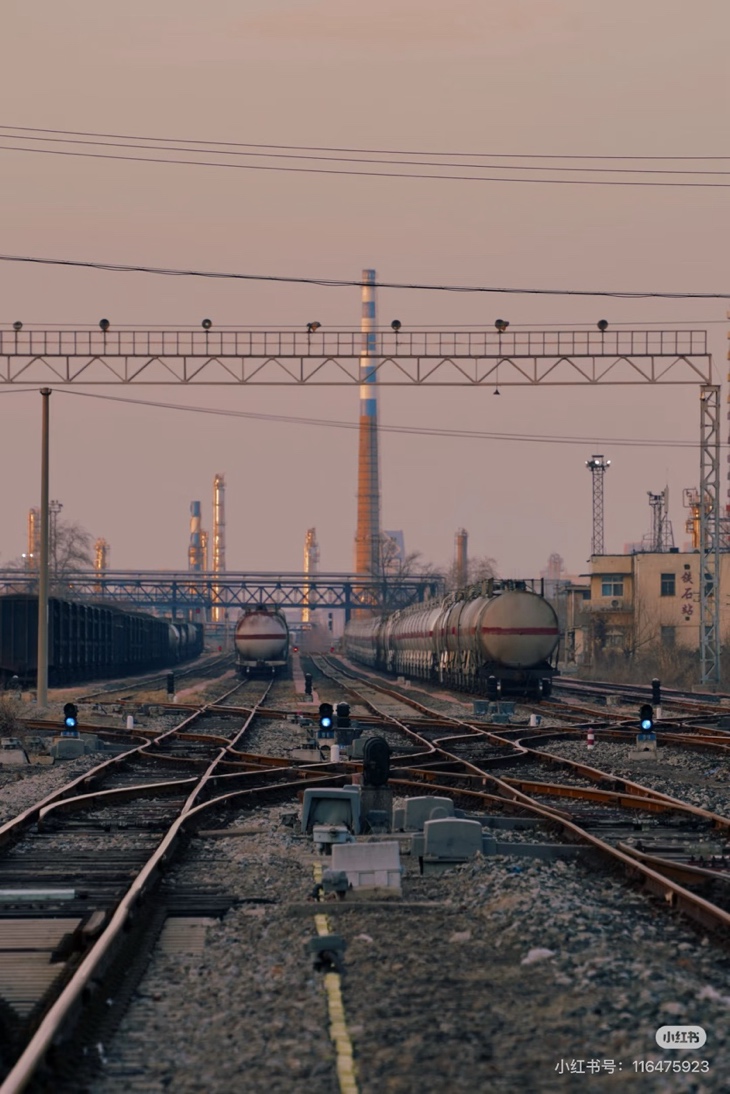
《石化生活》,齐鲁石化工业区景观,来自小红书帐号LuckyKevin
生于八〇尾巴的我,赶上了大制造工业成形与互联网信息产业崛起的转折。一定程度上,第二产业向第三产业的转移不仅仅是2000年到2020年的主叙事,也成为我个人叙事的暗流。“城市"这个概念在我少年记忆里相连的物境,并非玻璃幕墙写字楼,或者巨大人流的十字路口;而是宏大的工厂,一根根的烟囱,以及像Windows早年的屏保一般错综复杂的银色管道。这是工业区的场景;另一半是"配套"的生活区,工厂员工生活的地方。除了无可避免而受影响的空气质量之外,生活区域在大多数时候感受不到工厂的痕迹,有的只是热闹的菜市场,一栋栋的小区建筑,以及骑车上下学的学童。“配套"这一概念映射出一种关于设施如何存在的思路:生活区域附属于生产单位,居住是为了劳动而被安排的功能。当这种逻辑被贯彻到底——如洛斯阿拉莫斯(Los Alamos)在建立之初为制造核弹而平地起城那样29——每一件物的存在都被其功用穷尽,万物成为透明的手段,人无法在其中栖居,无法与存在者照面,世界难以展开,意义难以附着。
我成长的小城自然不同于这样的规划蓝图。小城在工业化之前本就存在,所以存在诸多并不方便于工业生产的物件,它们无法被"配套"的逻辑收编。出城不远处就是宽大的国道,成片的卡车,穿越国道,就来到大片的农田,华北平原典型的景观;小城也有自己的历史:古时候是某国的都城,虽然并没有因此成为旅游景点,但仍然在城里城外洒落着简陋却仍被维护着的博物馆和考古坑。也是因此,街道的命名也都反映出这样的历史。居民聚集的地方距离工厂区着实也有很大的距离,至少对于少年时只有自行车的我来说,遥远得无法穿越。正如许多其他的工业城市,在小城居住区的边界,布满了铁轨,以及不知何时存在又关闭的工厂。少年的我和小伙伴们偶尔来到这里,翻墙进入这些可能是关闭十年或三十年的工厂,偷拿几块废铁,卖钱来买雪糕。对我们来说,这边界就如边境一般,是世界与世界之间的分界线,仿佛有某种严肃的结界将两边分离。“再往前,你便是身处一个不同的世界了”——这种讯号从一草一木和路边生锈的机械中传来。于是年少的我和小伙伴们也就从未再往前跨越那阈境。仿佛父母的班车是唯一能够穿越边界前往工业区的器具,就如同要渡过斯提克斯河,唯有通过卡戎的船才可能。30
据父母辈的回忆,小城曾经是不同的世界,充沛的河水以及更多的农田,在他们成长的年份中被巨大的工厂、成吨的钢铁与数不尽的卡车逐渐置换,那世界现今只存在于刘亮程的文字之中。然而这工业所打开的新世界,却也成为了新一辈人生活的感性条件。于我而言,离开小城已二十余年的现在,在梦境中却仍然布满冒着白气的高耸的烟囱,冬日空气里特有的青草的味道。就连一辆应该出现在布鲁克林的塔克卡车(taco truck)也出现在小区的入口街道上,与食堂的后门相连。总是与这些事物共同出现的,还有大背头的显示器,以及Windows 98或者XP的开机音效。这些大大小小的触摸与听觉,出于塑料,出于钢铁。这些质料并非作为知觉的对象被一一辨认,而是作为一种弥散的情调(Stimmung)31——在我们尚未注意到它的时候,已经将我们安置于一个特定的世界之中,并以它们自己的方式向我们展开一个记忆能够粘连、栖居乃至延涨的世界。
而当那个承载着工厂的天际线、锈铁变成的少年手中的雪糕、遍布城市边界的铁轨,以及半夜时分从遥远地方传来的火车汽笛声的世界在逐渐退隐、逐渐变得模糊时,我们却发现自己慢慢置身于一种缘情消解之后的空茫之中。那本应到来的世界尚未——或许总已未能——到来,取而代之的是些许无法命名的行为与物品占据了我们当下的注意。
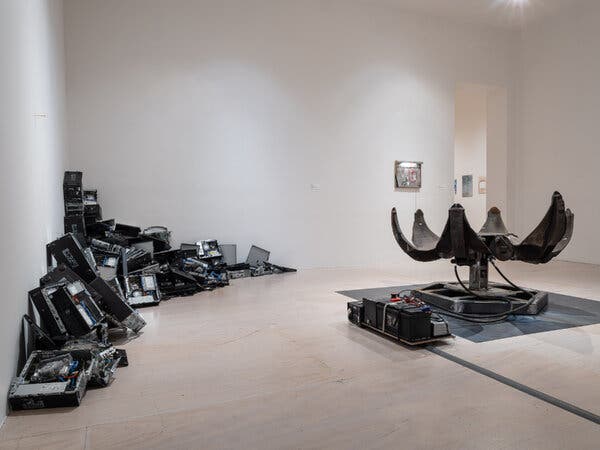
波黑艺术家塞尔玛·塞尔曼(Selma Selman)的作品《生之花》(Flower of Life),2024,一只垃圾场起重机的爪子。背景左侧为由拆开的电脑机箱制作的作品《主板》(Motherboards),2025,以及用从电子垃圾中回收的黄金铸造的作品《钉》(Nail),2025,MoMA PS1展览现场,摄影:Kris Graves
Bosnian
在2025年夏季MoMA PS1的大型展览"聚集者”(The Gatherers)上,遍布展厅的仍然是巨大的机械以及零件、影像作品中居家杂乱的物件、散落在角落的五金工具以及各种大概可以被称作垃圾的塑料小东西——这全都无疑是现代性的标志产物,被制造于各式工厂的车间,与那瓷砖铺设的外墙、高耸的烟囱、遥远的汽笛声属同一世界。此展览的策展人鲁巴·卡特里布(Ruba Katrib)在一篇采访中谈到:“有某种可触知的东西浮现出来。扫描仪的声音,建筑抓斗的声音,然后每隔四分钟,克拉拉·利登(Klara Lidén)的标牌就会旋转一次。机械的声音以某种特定的方式重复着,创造出一种令人回味的节奏。这些声音诉说着某种难以用语言表达的品质,而这恰恰是展览和艺术所能做到的事情。”32 如果说艺术品具有"将一个世界带入在场”(putting forth a world)的能力,是保持着那种"世界”(Welt)与"大地”(Erde)之间张力的场所33,那么在第二产业之退隐与信息技术之主体化的双重运动中,后者是否能够像前者一样将一个新的世界带入在场呢?
信息哲学家卢西亚诺·弗洛里迪(Luciano Floridi)早在2007年的一篇论文中便预言,我们正在进入一个以信息为本体的世代——物理世界将不再享有本体论上的优先地位,而仅仅成为"信息圈”(infosphere)的一个子集。34 弗洛里迪在表达这样的断裂式变化时并不持有任何支持与反对的伦理态度,这使得他的判断更加可信。
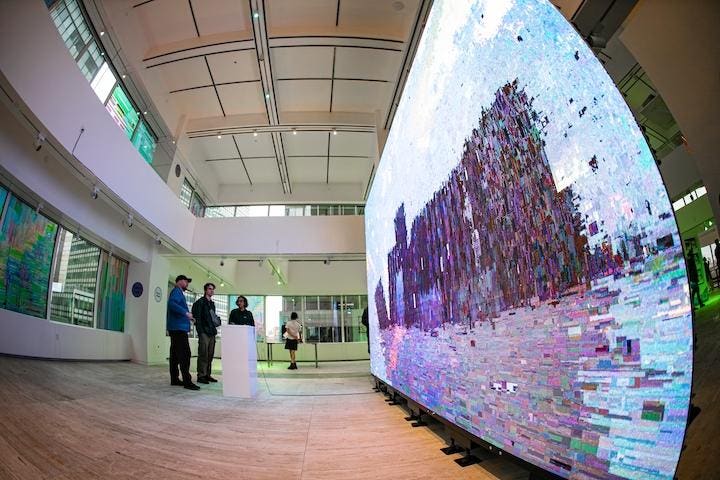
曼哈顿下城举办的盛大数字艺术展"根茎世界"内景,摄影:Alexey Kim
“根茎”(Rhizome)是网络艺术领域最重要的研究与存档机构,其所涉猎的数字艺术是此类别中最"软"的种类——纯粹存在于赛博世界中。在MoMA PS1的"聚集者"展览几乎同一时间,“根茎"也举办了大型实地展览"根茎世界”(Rhizome World)——一个试图以纯粹的软件聚集世界的尝试。与PS1展览的不同之处在于,如果不插电,现场看起来像是不同屏幕显示技术的展示会:十七寸、三十寸的显示器,有的摆在桌上,有的挂在墙上,还有投影机及其所需的幕布,以及LED落地屏。这算不上密集的屏幕阵列并不像典型艺术展览,或者如果用力去想象,也许它让我们想起早期的网吧——一排排的屏幕与桌椅。然而,与网吧的不同也相当明显:它是干净且规整的。如所知,看展者所去观看的并非屏幕本身,而是屏幕之中的东西。屏幕及键鼠这些硬件,仅是为了让屏幕之中的东西显现于我们,是展览内容得以呈现的载体。“根茎"机构本身的藏品中,不乏涉及早期互联网的体验,一些介于软件和游戏之间的东西,它们展示的声音与视觉,也不止一次地让我回到某个万维网的时代以及它所承诺的那些色彩。我再三前往"根茎世界”。但在离开展览之后的许多天里,当我试图回忆起展览所呈现出的"世界"时,却似乎闻到了小时候微机房里那温热塑料的味道。如果说"根茎世界"之中的"世界"意图成为一个海德格尔式的世界,它所意指的世界很难逃离网吧或者办公室这样的托付之所。在我搜索关于"根茎世界"的评论时,意外地发现了一篇独立评论,直指数字网络艺术的某种困境:“我们家里都有屏幕,为什么还要去博物馆看更多的屏幕?”35
软件到底是什么?显然,把它们当作同实在之物一样的"物”,是有悖直觉的。在媒介研究者全喜卿(Wendy Hui Kyong Chun)的著作*《Programmed Visions:Software and Memory》*中,她提到在软件刚刚诞生之际,发生过一起软件工程师意图给软件注册专利但被法院驳回的案例。法院驳回的理由,是认为软件同属于自然科学的发现,属于某种数学发现或自然定理。36 也就是说,软件起初被视为一种认识论仪器。虽然在后续的发展过程中,因为诸多经济考量,软件最终可以被当作商品售卖,但在很长的时间内,它的物理媒介——光盘或者软盘——仍然是那个被实际售卖的东西。那些在光下显出五颜六色的光盘,摸上去又涩又滑,成为了早期国内电脑城的某种视觉符号。
在书的中间部分,全喜卿的分析落到了软件之为逻各斯(logos)和行为(action)的层面。就如另外一位软件研究学者亚历山大·加洛韦(Alexander Galloway)在*《The Interface Effect》*中所展开的那样: “计算机是一种伦理(Computer is an ethic)”37。38 虽然全喜卿一定程度上拒绝了弗里德里希·基特勒(Friedrich Kittler)“软件为硬件电压之不同”,即"软件并不存在"的观点,39 但就某些物能够"打开和保持一个世界"的角度来说,基特勒与全喜卿应该并无异议。软件既可以仅仅是差异(difference),又可以是逻各斯,或者行为准则。但是几位学者的共通之处是一种否定:否定软件之为"物"的性质,而分别指向它不同的奇异的存在方式。它只能对已有的事物进行意义和关系的改造,而非本体上的加减,如平地而起的厂房,被改造成农田的森林,堆积成山的煤渣,以及空气中漂浮的小颗粒。在这个方面来看,软件似乎不具有海德格尔所提到的"物性”(thingly character)40,它不像壶或者桥那样可以"聚集"一个世界,开启一片澄明(Lichtung)。相反,如加洛韦所理论的那样,它作为一种对既存之物的作用(effect);或如全喜卿所言,影响且转化我们对世界本身的时间性结构。
在以智能手机领头的、无处不在的个人互联到来之后,公交车仍是公交车,它的机械设计与构造并没有发生大变化,但公交车作为等待之对象、作为通勤之器具、作为城市交通之节点——这些"作为"本身则成为信息产业所在效应层的作用对象:生产数据,即被再构为意义网络的信息。自从千禧年以来,信息技术已成为解决任何问题的默认技术。于是就连"信息技术”(IT)这个古老的名字都退居幕后,转而被"高新科技"这样笼统的词语代替,言下之意高新科技即信息技术。这是一个本体论和认识论的巨大断裂,却在物理世界几乎听不到它的存在,当然,除了那些不停地被建造的巨大的数据中心。但就连这些庞大的建筑,也往往被隐藏在人烟稀少的地域,隐于人们的日常思索之外。软件的存在方式,首先是对既有世界的效应,对那人所存在的"指引整体”(referential totality),即海德格尔的"世界"的再塑41——作用于那张让存在者作为其所是而显现的意义之网络。
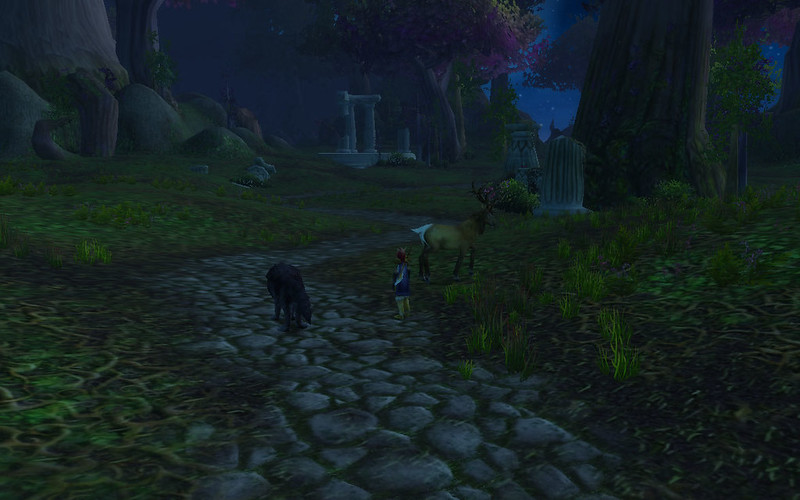
魔兽世界"灰谷"森林。来源:Darknihm / Flickr,采用 CC BY-NC-SA 2.0
然而,如果我们认可软件的本质为逻各斯,抑或是行为准则;同时,如果我们同意麦克卢汉(Marshall McLuhan)的观察,即"媒介总是包含其他的媒介"42——那么,迄今为止的大部分软件,就并非一种纯粹的软件——那早先被认为是同数学发现一样的东西——而是传统媒介的大集合:包含图片、视频、声音。软件开发中的"Media"文件夹、游戏开发中庞大的"Assets"目录,都指向同一个事实:在很长时间内,软件是一种复合体,既有行为逻辑、逻各斯,也有大量的"旧媒体"。九十年代著名的播放器软件Winamp,作为一个年代的符号,就是一款满载着巨量位图文件的"复合式"软件。《魔兽世界》将这种复合推至数GB的规模,数百位设计者将实录的鸟鸣、管弦乐团的演奏、手绘的概念画稿转写进同一个安装包之中。它进入中文世界时的宣传词"一个世界在等待"竟也诚实:对于生活经验仅限华北平原的少年而言,艾泽拉斯给了我第一片密林、第一片沙漠和第一片沼泽。泰达希尔远古巨树之间弥漫的音响、艾尔文森林午后的光线、荒芜之地干燥旷野上远处传来的鼓声——这些都以一种我从未遭遇过的感性密度,在身体中沉积为某个世界的最初经验。多年后在东北部的山林间远足,秋天阔叶林的静谧和鸟虫的声响同时唤起其本身的展现,而其中却也同时携带着艾尔文森林的气息。
如果说复合式软件可以在身体中沉积出某种世界的最初经验——这种沉积之所以可能,是因为复合体中的"旧媒体"材料携带着自身的历史性,许煜在*《Recursivity and Contingency》*中将"历史性"定位为过去经验作为未完成的条件,持续参与当下之构成的时间结构43,而参数张量中的统计关系并不保留这种未完成性——它将过去压平为概率分布。那么问题就并非"软件本身是否可以推出一个世界",而成为:何种形式的软件,以及,何谓软件的"创作"。
然而,自2010年代以来,一种新的软件开始进入大众的每日视野——从全喜卿和加洛韦的理论角度来看,它甚至比早期的DOS更加接近纯粹意义上的软件——一种纯粹的数学操作,称之为"纯然之软件"(mere software)44也许更加恰当。
2023年,美国插画师莎拉·安德森(Sarah Andersen)等人对Stability AI、Midjourney提起集体诉讼,谴责AI公司偷窃艺术家的图像并"存储"在模型之中。45这一符合直觉的解释却打错了靶子:技术上,严格地说,模型并没有"存储"任何单独的媒体,而仅仅是数以亿计的数字以及代数关系——一组高维参数张量。如研究者埃里克·萨尔瓦吉奥(Eryk Salvaggio)所分析,大模型属于统计模型,而非公众意识中的"解释模型"(explanatory models)——统计模型对其数据不具有理解力,也不具有任何关于因果的假说,仅仅是像画地图一般地生产数据与数据之间的关系。46 正因如此,“幻觉"并非模型偶尔的故障,而是模型生成的唯一形式——模型时时刻刻都在产生幻觉。而这幻觉本身是去历史的——其无序的生成并非来自历史的沉积,而是纯粹的概率涌现。47
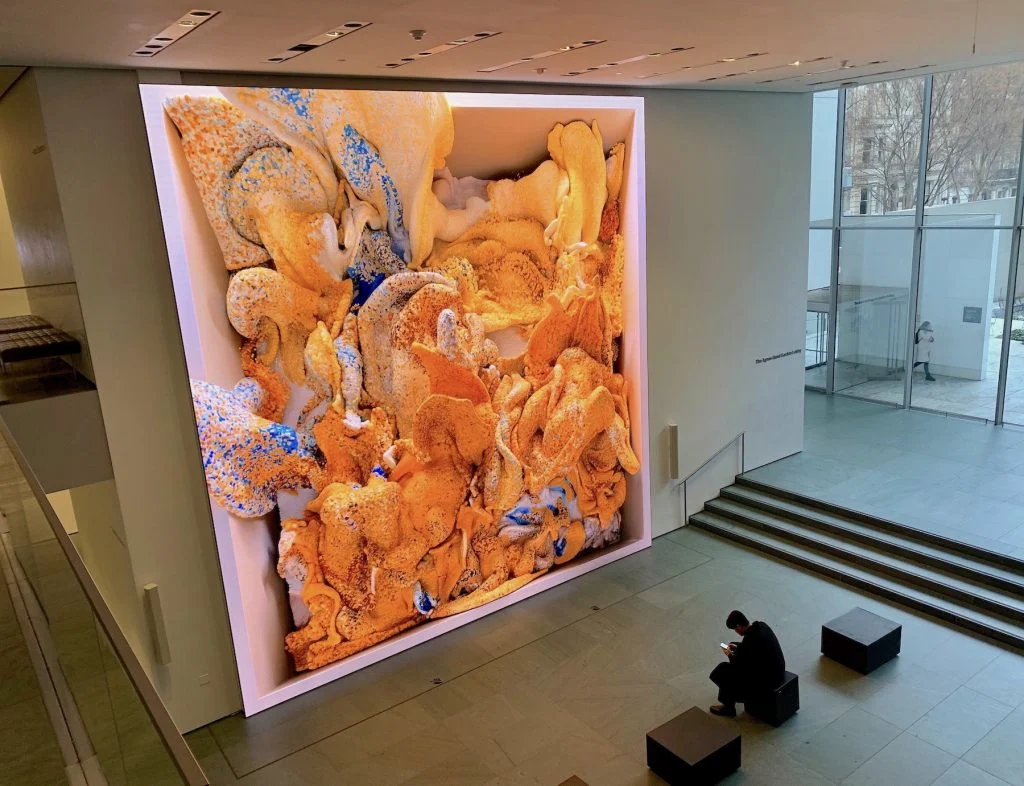
雷菲克·阿纳多尔,《无监督》,2012,MoMA.摄影:Ben Davis
正因为大模型被理解为某种生成式的引擎,使用其创作艺术品就自然成为了许多艺术家探索的方向。雷菲克·阿纳多尔(Refik Anadol)的《无监督》(Unsupervised)在2022年冬季现身于MoMA大厅,其抽象的颜色和线条在巨大的屏幕上来回变幻。艺术评论家杰瑞·萨尔茨(Jerry Saltz)称其为"耀目的熔岩灯”。48 作品使用MoMA馆藏数据训练模型这一事实,本可以成为某种世界的入口:倘若观者能够在流动的形态中辨认出蒙德里安的网格、波洛克的滴洒,作品便有可能成为一个关于现代艺术史的冥想装置。但阿纳多尔选择的视觉语言恰恰阻断了这种追溯的可能——“窗口"暗示着屏幕背后有一个可供进入的空间,但这个空间除了更多的颗粒之外一无所有。
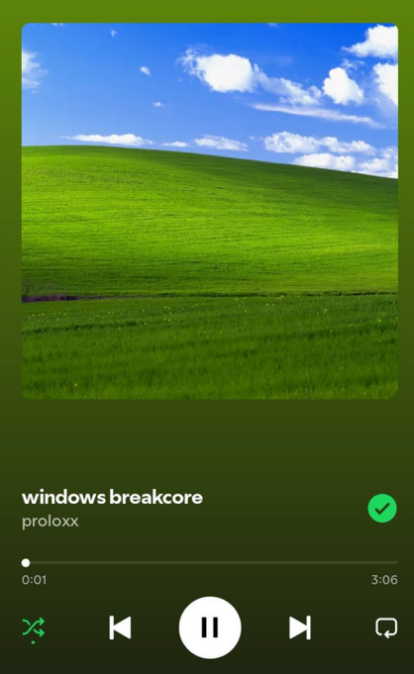
音乐作品"Windows Breakcore"在当代流媒体平台Spotify中的呈现,来源:Spotify界面截图
正如雷诺兹所观察到的,当代音乐生产大量借力于混音(remix)与采样(sampling),由此产出的作品徘徊在对过往的致敬与直接挪用之间,界限暧昧难辨。49在这一系列"新"类别中,出现了一支常被称作"TikTok碎核”(TikTok Breakcore)的分支50。这些作品拥有一套高度可辨识的视听符号:专辑封面几乎无一例外地采用神情阴郁的日系动漫少女形象;密集快速的电子鼓点制造出一种无法拒绝的机械推进感;在这律动之上,却漂浮着空灵飘渺的旋律线——从九十年代日本动画原声、早期电子游戏配乐中采样而来的片段,经过处理后仍保留着某种哀伤的甜腻。对于成长于九十年代的人来说,这恰恰处于所谓第二波中日交流稳定期,电视台在傍晚六点左右放映许多日漫,而这些采样不急不躁地出现在"TikTok碎核"之中。除此之外,许多旧世界的元素也被混于其中,比如Windows 95的开机声音,被做成名为"Windows Breakcore"的曲目,在YouTube上获得了两百多万的播放量。其封面就是Windows XP那著名的绿草地蓝天——这张图如此经典,以至于它已经成为了小红书上"经济上行时期的审美"这一标签的代表性图像。我常常在街头骑车穿越车流的通勤时刻,耳机中轰鸣着这样的音乐,密集快速却机械规律的鼓点拽着亦如机械的身体快速前行,缓慢忧郁的旋律线却不停地回望,夹带着九十年代动漫声优的少女声音。也可能正因为这些来自旧世界的采样指向一个沉厚的世界,碎核音乐家抓住这些旧世界的碎片,竭力拼出一个可供栖身的澄明。就在这身体被鼓点驱动向前,心灵却攥着旋律回望之时,当意义的基础设施逐渐成为去历史的颗粒——而那些曾经在安装包中为我们保存过一整个世界的东西,也正在被同一种力量溶解——念想与情感便失去了栖身之所,努力抓向那逐渐消失在车窗外的过去。
(作者单位:艺术家)
-
Kurt Andersen. “You Say You Want a Devolution?” Vanity Fair, January 2012. ↩︎
-
Simon Reynolds. Retromania: Pop Culture’s Addiction to Its Own Past. New York: Farrar, Straus and Giroux, 2011. ↩︎
-
Hartmut Rosa. Social Acceleration: A New Theory of Modernity. Trans. Jonathan Trejo-Mathys. New York: Columbia University Press, 2013. Rosa introduces the concept of the “shrinking of the present” to describe the accelerating obsolescence of past experience. ↩︎
-
On the history of Los Alamos as a “purpose-built city,” see Jon Hunner. Inventing Los Alamos: The Growth of an Atomic Community. Norman: University of Oklahoma Press, 2004. ↩︎
-
In Greek mythology, the River Styx marks the boundary between the worlds of the living and the dead, and Charon is the ferryman who conveys souls across. ↩︎
-
Heidegger defines Stimmung (“attunement” or “mood”) in Being and Time as the way Dasein is always already thrown into the world prior to cognition—a fundamental disposition that has already placed us within a particular situation. See Martin Heidegger. Being and Time. Trans. John Macquarrie and Edward Robinson. New York: Harper & Row, 1962, §29–30. ↩︎
-
Ruba Katrib interview, in “MoMA PS1 Chief Curator Ruba Katrib Talks ‘The Gatherers’ Exhibition and What Art Can and Can’t Do.” ARTnews, June 2, 2025. ↩︎
-
In “The Origin of the Work of Art,” Heidegger takes the “thingly character” (das Dinghafte) as the starting point for questioning the mode of being of artworks, examining three traditional determinations of the thing before ultimately situating the work as the site of strife between “world” and “earth.” See Martin Heidegger. “The Origin of the Work of Art.” In Poetry, Language, Thought. Trans. Albert Hofstadter. New York: Harper & Row, 1971. ↩︎
-
Luciano Floridi. “A Look into the Future Impact of ICT on Our Lives.” The Information Society 23, no. 1 (2007): 59–64. Floridi predicts that the infosphere will shift from denoting an information space to becoming synonymous with “Being”—the physical world will no longer enjoy ontological priority but will merely become a subset of the infosphere. ↩︎
-
“We Have Screens at Home.” ROUGH IDEA (Patreon), May 23, 2025. ↩︎
-
Wendy Hui Kyong Chun. Programmed Visions: Software and Memory. Cambridge, MA: MIT Press, 2011. ↩︎
-
Here ethic should not be understood as “ethics” in the moral sense. Galloway draws on the original Greek ἦθος, meaning an habitual mode of conduct and internal operating logic, rather than a normative code of right and wrong. Heidegger, in his “Letter on Humanism,” traces ἦθος back to “abode” (Aufenthalt), the manner of human dwelling—the computer as ἦθος is a way of being that prescribes how one dwells within it. ↩︎
-
Alexander R. Galloway. The Interface Effect. Cambridge: Polity Press, 2012. ↩︎
-
Friedrich Kittler. “There Is No Software.” Stanford Literature Review 9, no. 1 (Spring 1992): 81–90. ↩︎
-
In “The Origin of the Work of Art,” Heidegger takes the “thingly character” (das Dinghafte) as the starting point for questioning the mode of being of artworks, examining three traditional determinations of the thing before ultimately situating the work as the site of strife between “world” and “earth.” See Martin Heidegger. “The Origin of the Work of Art.” In Poetry, Language, Thought. Trans. Albert Hofstadter. New York: Harper & Row, 1971. ↩︎
-
In Being and Time, Heidegger defines “referential totality” as the network of meaning constituted by the mutual referral of equipment. See Being and Time, §18. ↩︎
-
Marshall McLuhan. Understanding Media: The Extensions of Man. New York: McGraw-Hill, 1964. ↩︎
-
Yuk Hui. Recursivity and Contingency. London: Rowman & Littlefield International, 2019. ↩︎
-
Here I borrow Heidegger’s usage of “mere thing” (bloßes Ding) from “The Origin of the Work of Art”—a thing stripped of the tension between world and earth, left with only material attributes—and repurpose it for a software ontology: software stripped of its composite old-media elements, left with nothing but logos or pure relationality. ↩︎
-
Sarah Andersen et al. v. Stability AI Ltd. et al., No. 3:23-cv-00201 (N.D. Cal. filed Jan. 13, 2023). ↩︎
-
Eryk Salvaggio. “No Mathematical Theory.” Cybernetic Forests (Substack), September 8, 2024. ↩︎
-
Ibid. ↩︎
-
Jerry Saltz. “MoMA’s Glorified Lava Lamp.” New York Magazine, February 22, 2023. ↩︎
-
Simon Reynolds. Retromania: Pop Culture’s Addiction to Its Own Past. New York: Farrar, Straus and Giroux, 2011. ↩︎
-
The prefix “TikTok” is appended to “breakcore” because these tracks are technically closer to atmospheric drum and bass or melodic jungle than to breakcore’s own violent, shredding aesthetic—a terminological confusion that has accordingly drawn the ire of breakcore purists. ↩︎
-
Kurt Andersen. “You Say You Want a Devolution?” Vanity Fair, January 2012. ↩︎
-
Simon Reynolds. Retromania: Pop Culture’s Addiction to Its Own Past. New York: Farrar, Straus and Giroux, 2011. ↩︎
-
Hartmut Rosa. Social Acceleration: A New Theory of Modernity. Trans. Jonathan Trejo-Mathys. New York: Columbia University Press, 2013. 罗萨在书中提出"当下的收缩"(shrinking of the present)这一概念,用以描述过去经验加速过期的现象。 ↩︎
-
关于洛斯阿拉莫斯作为"目的城市"的历史,参见Jon Hunner. Inventing Los Alamos: The Growth of an Atomic Community. Norman: University of Oklahoma Press, 2004. ↩︎
-
希腊神话中,斯提克斯河(Styx)为阴阳两界的分界,卡戎(Charon)为摆渡亡灵过河的船夫。 ↩︎
-
海德格尔在《存在与时间》中将"情调"(Stimmung)定义为此在先于认知而被抛入世界的方式,是一种总已将我们置于特定处境之中的基本情态。参见Martin Heidegger. Being and Time. Trans. John Macquarrie and Edward Robinson. New York: Harper & Row, 1962, §29–30. ↩︎
-
Ruba Katrib采访,见"MoMA PS1 Chief Curator Ruba Katrib Talks’The Gatherers’ Exhibition and What Art Can and Can’t Do.“ARTnews, June 2, 2025. ↩︎
-
海德格尔在《艺术作品的本源》中将"物性”(das Dinghafte)作为追问艺术作品之存在方式的起点,依次考察了三种传统的物之规定,并最终将作品定位为"世界"与"大地"之间争执的发生场所。参见Martin Heidegger. “The Origin of the Work of Art.” In Poetry, Language, Thought. Trans. Albert Hofstadter. New York: Harper & Row, 1971. ↩︎
-
Luciano Floridi. “A Look into the Future Impact of ICT on Our Lives.“The Information Society 23, no. 1 (2007): 59–64. 弗洛里迪在文中预言,信息圈(infosphere)将从指称信息空间的方式,变为与"存在”(Being)同义——物理世界将不再享有本体论上的优先地位,而仅仅成为信息圈的一个子集。 ↩︎
-
“We Have Screens at Home.“ROUGH IDEA (Patreon), May 23, 2025. ↩︎
-
Wendy Hui Kyong Chun. Programmed Visions: Software and Memory. Cambridge, MA: MIT Press, 2011. ↩︎
-
此处ethic不宜理解为"伦理”。加洛韦所取的是希腊语 ἦθος的原义,即一种惯常的行为方式与内在运作逻辑,而非关于善恶的道德规范。海德格尔在《论人道主义的信》中曾将 ἦθος 追溯至"居留之所”(Aufenthalt),人之栖居的方式——计算机作为一种 ἦθος,即是一种规定了人如何居留于其中的行事之道。下文使用"行为准则"或者"行则"作为其中文翻译。 ↩︎
-
Alexander R. Galloway. The Interface Effect. Cambridge: Polity Press, 2012. ↩︎
-
Friedrich Kittler. “There Is No Software.” Stanford Literature Review 9, no. 1 (Spring 1992): 81–90. ↩︎
-
海德格尔在《艺术作品的本源》中将"物性”(das Dinghafte)作为追问艺术作品之存在方式的起点,依次考察了三种传统的物之规定,并最终将作品定位为"世界"与"大地"之间争执的发生场所。参见Martin Heidegger. “The Origin of the Work of Art.” In Poetry, Language, Thought. Trans. Albert Hofstadter. New York: Harper & Row, 1971. ↩︎
-
海德格尔在《存在与时间》中将"指引整体"(referential totality)定义为器具相互指引所构成的意义网络。参见Being and Time, §18. ↩︎
-
Marshall McLuhan. Understanding Media: The Extensions of Man. New York: McGraw-Hill, 1964. ↩︎
-
Yuk Hui. Recursivity and Contingency. London: Rowman & Littlefield International, 2019. ↩︎
-
此处借用海德格尔在《艺术作品的本源》中对"纯然之物"(bloßes Ding)的用法——一种被剥除了世界与大地之张力后仅余物质属性的物,此处转用于指一种软件本体论,被剥除了旧媒体之复合性而后仅余逻各斯或关系性。 ↩︎
-
Sarah Andersen et al. v. Stability AI Ltd. et al., No. 3:23-cv-00201 (N.D. Cal. filed Jan. 13, 2023). ↩︎
-
Eryk Salvaggio. “No Mathematical Theory.“Cybernetic Forests (Substack), September 8, 2024. ↩︎
-
同上。 ↩︎
-
Jerry Saltz. “MoMA’s Glorified Lava Lamp.“New York Magazine, February 22, 2023. ↩︎
-
Simon Reynolds. Retromania: Pop Culture’s Addiction to Its Own Past. New York: Farrar, Straus and Giroux, 2011. ↩︎
-
之所以在碎核前冠以TikTok的前缀,是因为这些音乐在技术特征上更接近氛围鼓打贝斯(atmospheric drum and bass)或旋律丛林(melodic jungle),与碎核本身的暴烈切碎美学相去甚远,这一命名上的混淆也因此招致了碎核原教旨听众的不满。 ↩︎